

“Why did the boy cry when his parents got him a bicycle for his birthday?
…Because he has no legs”.
Stories are probably the most compelling way to communicate. Like most, I have many times watched Netflix into the night because I was effectively manipulated with story techniques such as cliffhangers, misdirection, foreshadowing, plot twists. And behind all of those, the promise of resolution. The “best” stories traditionally pull off a satisfying resolution.
Stories work with craving. The desire for resolution is also a kind of craving. Maybe that desire is inherent in all craving.
When thinking about past events, images, snippets of conversations, emotional tones, arise. When thinking about a person, it is similar. It’s a patchwork of aggregates. Much like in film. Both in film and in mind/body, images, auditory snippets, thought, and emotional tones are stitched together, and coalesce, congeal into some sort of resolution. In the mind/body, the resolution can be an opinion or at least a working impression.
In the documentary film You Can See Everything, Nathan Fielder and team stitch together video and audio recordings recordings of Elizabeth Holmes and her fiancé and their life leading up to Holmes’ incarceration.
Everyone is talking about it, with many people coming out of it saying: “what did I just watch”? There is no satisfying resolution in the film.
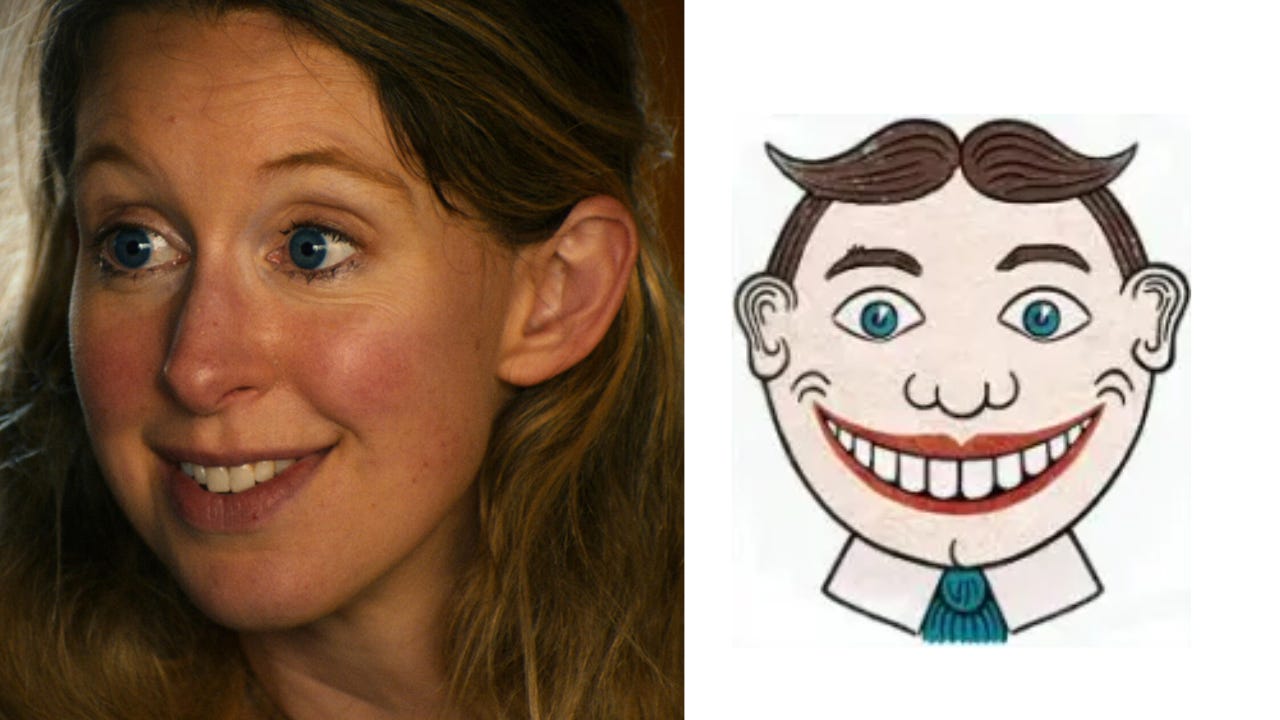
Is Elizabeth Holmes a complete sociopath with no tells whatsoever? Is Billy controlling and manipulating this lamb, this fae, with her enormous unblinking eyes, pointy ears and all? Are they both complete sociopaths? And how about Nathan?
Overall it does not compute. It does not resolve. The more you think about it, the more it spins out in several directions instead of coming together into a resolution, a story, a narrative. And I think this is the point. In this way it is not quite like any other documentary I’ve seen.
In the Buddhist teaching of In dependent origination, everything arises in dependence of causes and conditions, so nothing exists independently or permanently. The desire for resolution can be associated with 3 types of causes and conditions: craving, clinging and becoming:
“Craving has a certain momentum, a certain one-way direction, and when it becomes intense, it becomes clinging.
Now, one way that craving becomes clinging is that very fixed positions are taken; things become good or bad; they become worthy or unworthy; they become valuable or valueless….
with becoming (bhava) .. Your mind completely hardens around a specific identity to satisfy that clinging. You become an angry person, a victim, a defensive worker, or a greedy consumer. Your psychological environment shifts entirely to accommodate that ego-state.” – Christina Feldman
The movie doesn’t allow for resolution, does not allow a place for the mind to settle.
This movie left me in ….craving. A desire for resolution. It inspired a going down a rabbit hole of backstory on all three main characters: Holmes, Billy, Nathan. Listening to podcasts, reading the book about Theranos. I must know. I must form an opinion, a position.
The ultimate impression is that of being cruelly left in a dark funhouse of no-resolution, vaguely sinister, senseless and subtly cruel. Holmes: your eyes look terrified but your mouth is smiling…why?